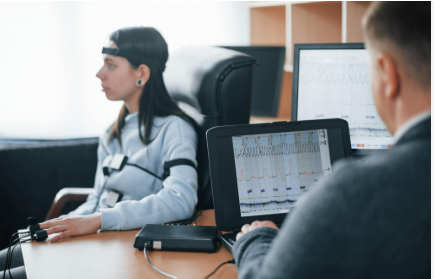
You’ve seen it in movies. Someone sits in a chair, wires clipped to their chest, a cuff squeezing their arm, a needle twitching across a graph. The examiner leans in and asks a simple question: “Did you do it?”
It looks like a machine that can see straight into your soul.
Here’s the thing—it can’t. Not really.
A polygraph test doesn’t detect lies. It measures the body. And the body is messy, emotional, and sometimes unpredictable. That gap between what it claims to do and what it actually does is where most of the confusion—and controversy—lives.
What a Polygraph Actually Measures
Strip away the drama, and a polygraph is just a collection of sensors. It tracks changes in breathing, heart rate, blood pressure, and skin conductivity. When you answer questions, the machine records how your body reacts.
The underlying idea is simple: when people lie, they feel stress. That stress shows up physically.
Sounds reasonable, right? It is… up to a point.
But stress doesn’t belong exclusively to lying. People get anxious when they’re falsely accused. They get nervous when they’re in a high-stakes situation. Some people panic just sitting in the chair, even if they’ve done nothing wrong.
Imagine this: you’re being asked about a missing item at work. You didn’t take it. But now you’re hooked up to a machine, someone is watching your every move, and your job might be on the line. Your heart rate ticks up. Your palms sweat.
The machine doesn’t know why.
The Structure Behind the Questions
Polygraph tests aren’t just random yes-or-no questions. There’s a method to how they’re asked.
Typically, the examiner mixes three types: irrelevant questions (“Is your name John?”), relevant ones tied to the issue (“Did you take the money?”), and control questions designed to provoke a reaction (“Have you ever lied to get out of trouble?”).
That last type is where things get interesting.
Control questions are meant to make almost anyone uneasy. Most people have lied at some point. So when they answer “no,” there’s a subtle internal conflict. That tension becomes a baseline.
Then your reaction to the relevant question is compared to that.
If your body reacts more strongly to the relevant question than the control one, the examiner may interpret that as deception.
It’s not mind-reading. It’s comparison.
Why Results Aren’t As Clear As They Look
Polygraph results often get presented as clean and definitive: pass or fail. Truth or lie.
Reality is fuzzier.
Different people react differently to stress. Some individuals are naturally calm under pressure. Others spike at the slightest discomfort. A person with anxiety might “fail” despite being truthful. Meanwhile, someone practiced at controlling their responses might appear steady even while lying.
There are also physical factors. Lack of sleep, caffeine, medications, even dehydration can affect readings.
Let’s say someone drinks three strong coffees before the test. Their baseline heart rate is already elevated. That alone can muddy the interpretation.
Examiners are trained to account for variables, but they’re still interpreting patterns, not reading facts. There’s judgment involved. And where there’s judgment, there’s room for error.
The Human Element in the Room
The machine gets the spotlight, but the examiner plays a huge role.
A good examiner doesn’t just hook you up and hit “record.” They spend time talking with you beforehand. They explain the process. They build a rhythm. In some cases, they’re also watching your behavior—how you answer, how you hesitate, how your tone shifts.
That interaction can shape the outcome more than people realize.
For example, if an examiner believes you’re being deceptive, they may push harder on certain questions. That pressure can amplify your stress, which then reinforces their interpretation.
It can become a feedback loop.
Now flip it. If they think you’re credible, they may interpret ambiguous signals more generously.
That’s not necessarily bias in a malicious sense. It’s just human nature creeping into a system that people often assume is purely mechanical.
Can People Beat a Polygraph?
This question comes up all the time, usually with a hint of curiosity—or suspicion.
The short answer: some people try, and sometimes it works.
There are techniques floating around, like controlling breathing, inducing small physical pain (pressing a toe, biting the tongue), or mentally rehearsing calming thoughts. The idea is to manipulate your physiological responses, especially during control questions, so that everything evens out.
Do these methods guarantee success? Not even close.
Experienced examiners are trained to spot unnatural patterns. Overdoing it can backfire. Sudden, inconsistent shifts in your readings can raise red flags.
But here’s the uncomfortable truth: the fact that these techniques exist—and sometimes succeed—tells you something important about the limits of the test.
If a system can be influenced by strategy, it’s not purely measuring truth.
Where Polygraphs Are Actually Used
Despite the debates, polygraph tests haven’t disappeared. They’re still used in certain areas, especially in law enforcement and government screening.
In some countries, they’re part of pre-employment checks for sensitive roles. In others, they show up during criminal investigations—not always as evidence in court, but as an investigative tool.
That distinction matters.
Many courts don’t accept polygraph results as reliable evidence. The reasoning is straightforward: the science isn’t strong enough to support definitive conclusions.
But investigators still use them to guide decisions. A failed test might lead to more questioning. A passed test might shift focus elsewhere.
Think of it less like a final verdict and more like a directional signal.
The Psychological Pressure Factor
Even when the machine itself is imperfect, the idea of it can be powerful.
People often believe the polygraph is highly accurate. That belief alone can influence behavior.
Someone who thinks they can’t beat the test might confess before or during it. Not because the machine forced the truth out, but because the pressure did.
There’s a well-known pattern: the pre-test interview becomes more revealing than the test itself. The examiner explains how accurate the machine is. The subject starts to doubt their ability to “get away with it.” That doubt turns into anxiety, and sometimes into admissions.
So in a way, the polygraph works partly because of psychology, not just physiology.
Common Misconceptions
One of the biggest misconceptions is that the polygraph detects lies directly. It doesn’t. It detects arousal—changes in your body that might be linked to stress.
Another is that it’s foolproof. It’s not. False positives and false negatives both happen.
There’s also the idea that if you’re innocent, you have nothing to worry about. That sounds comforting, but it’s not entirely true. Innocent people can fail. Guilty people can pass.
That’s not a flaw in individuals—it’s a limitation of the method.
A Small Scenario That Says a Lot
Picture two people taking the same test.
One is guilty but emotionally detached. Maybe they’ve rationalized their actions. Maybe they’re just unusually calm. Their responses stay steady.
The other is innocent but deeply anxious. They overthink every question. Their heart races. They worry about being misunderstood.
If you only look at the physiological data, the second person might appear more deceptive.
That’s the core problem in a nutshell.
So, Should You Trust a Polygraph?
It depends on what you expect from it.
If you think it’s a truth machine, something that can cleanly separate honesty from deception, you’re setting yourself up for disappointment.
If you see it as a tool that can provide clues—signals that need careful interpretation—it makes more sense.
Even then, it shouldn’t stand alone. Context matters. Evidence matters. Human judgment matters.
Polygraphs can be useful in certain situations, especially when combined with other investigative methods. But they’re not definitive. They never were.
The Takeaway
The polygraph test sits in an odd space between science and storytelling. It looks precise, almost clinical, yet it leans heavily on interpretation and human behavior.
It measures your body, not your truth.
That distinction is easy to miss, especially when the setup feels so authoritative. Wires, charts, controlled questions—it all suggests certainty. But underneath, it’s still a system trying to make sense of complex, emotional human reactions.
And humans, as you probably know from experience, don’t always follow clean patterns.
So if you ever find yourself facing a polygraph, remember this: it’s not reading your mind. It’s reading your reactions. And those two things are not the same.